
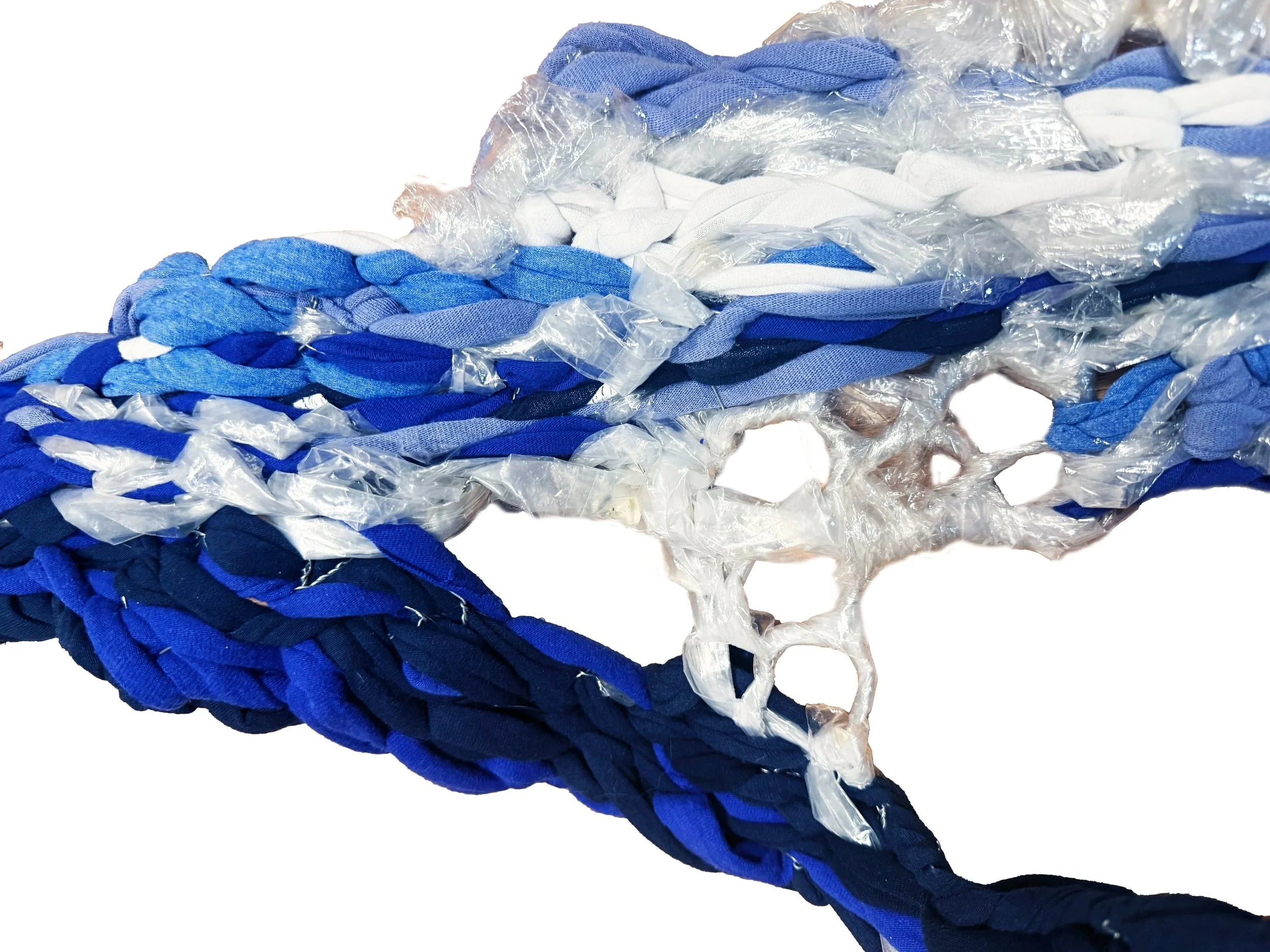
Woven River: What Ties Us to the Land
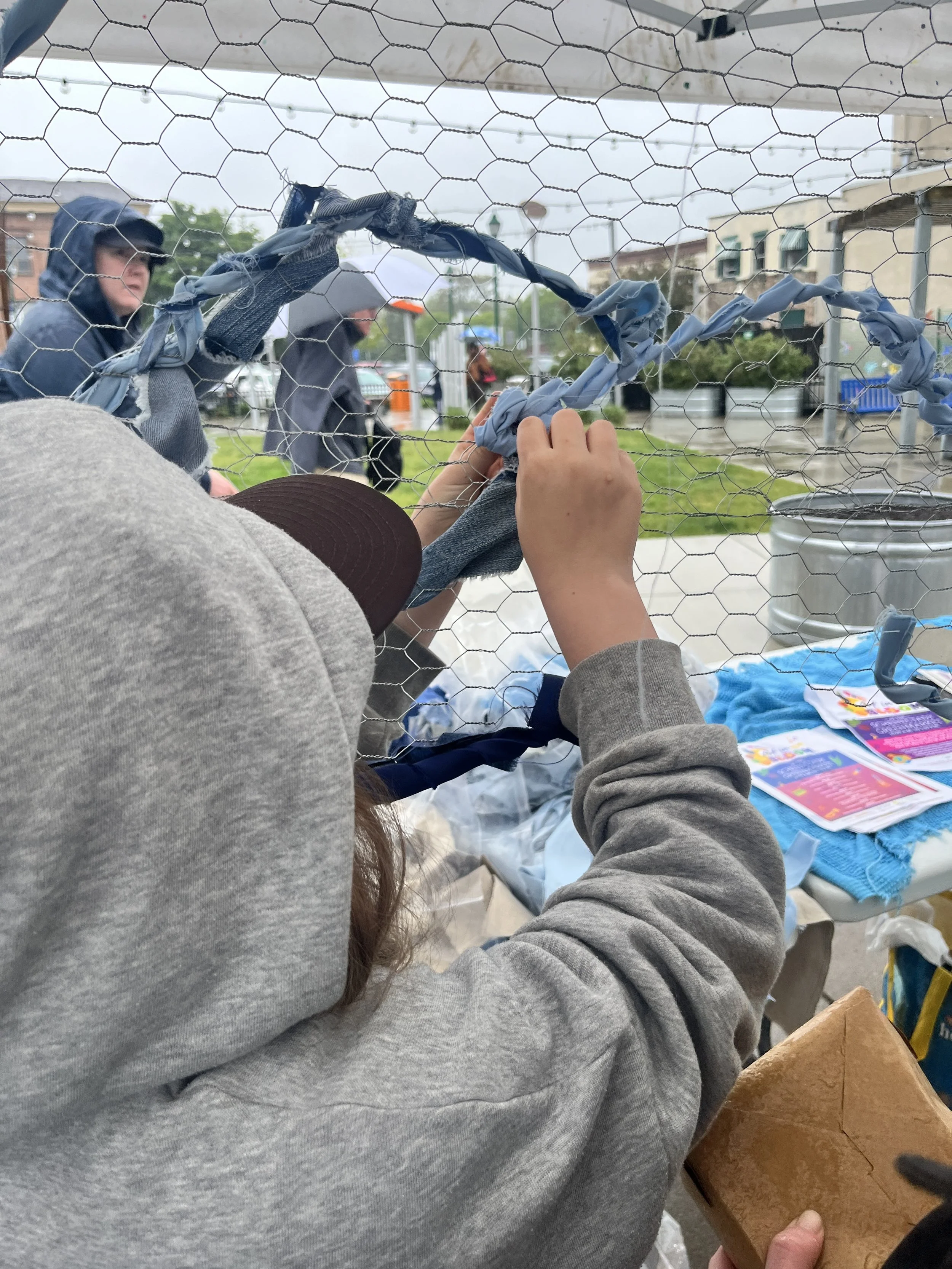
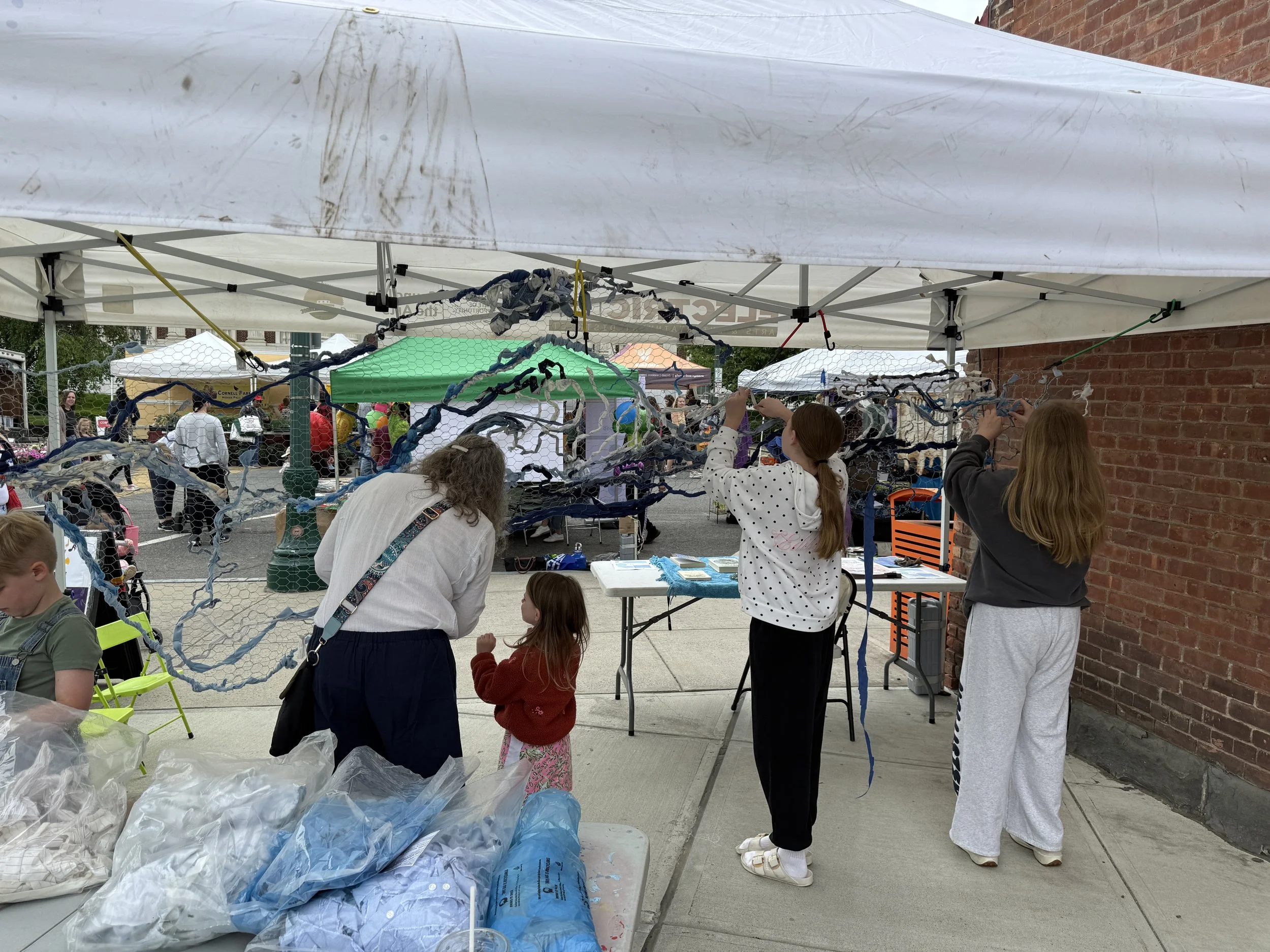
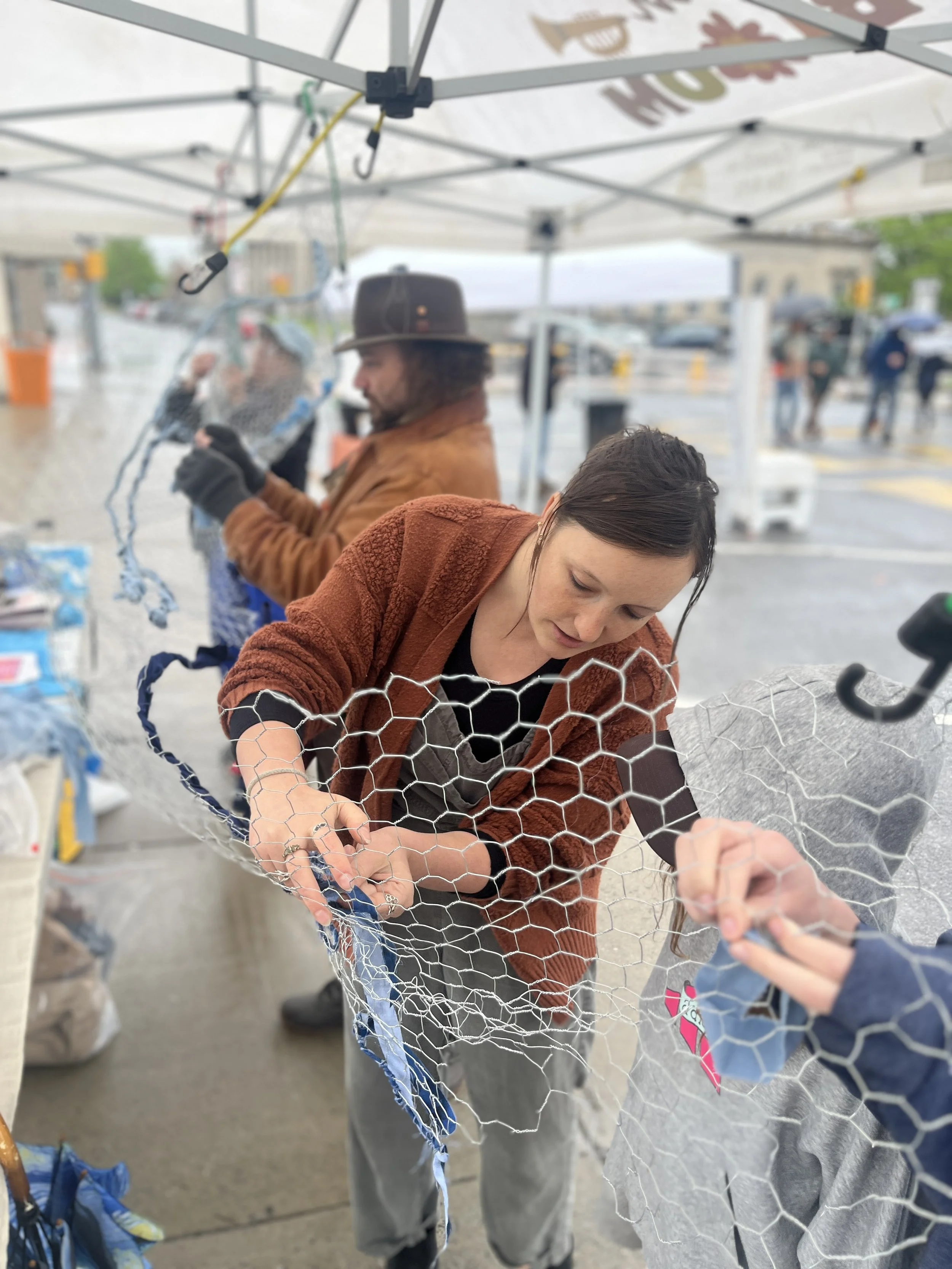
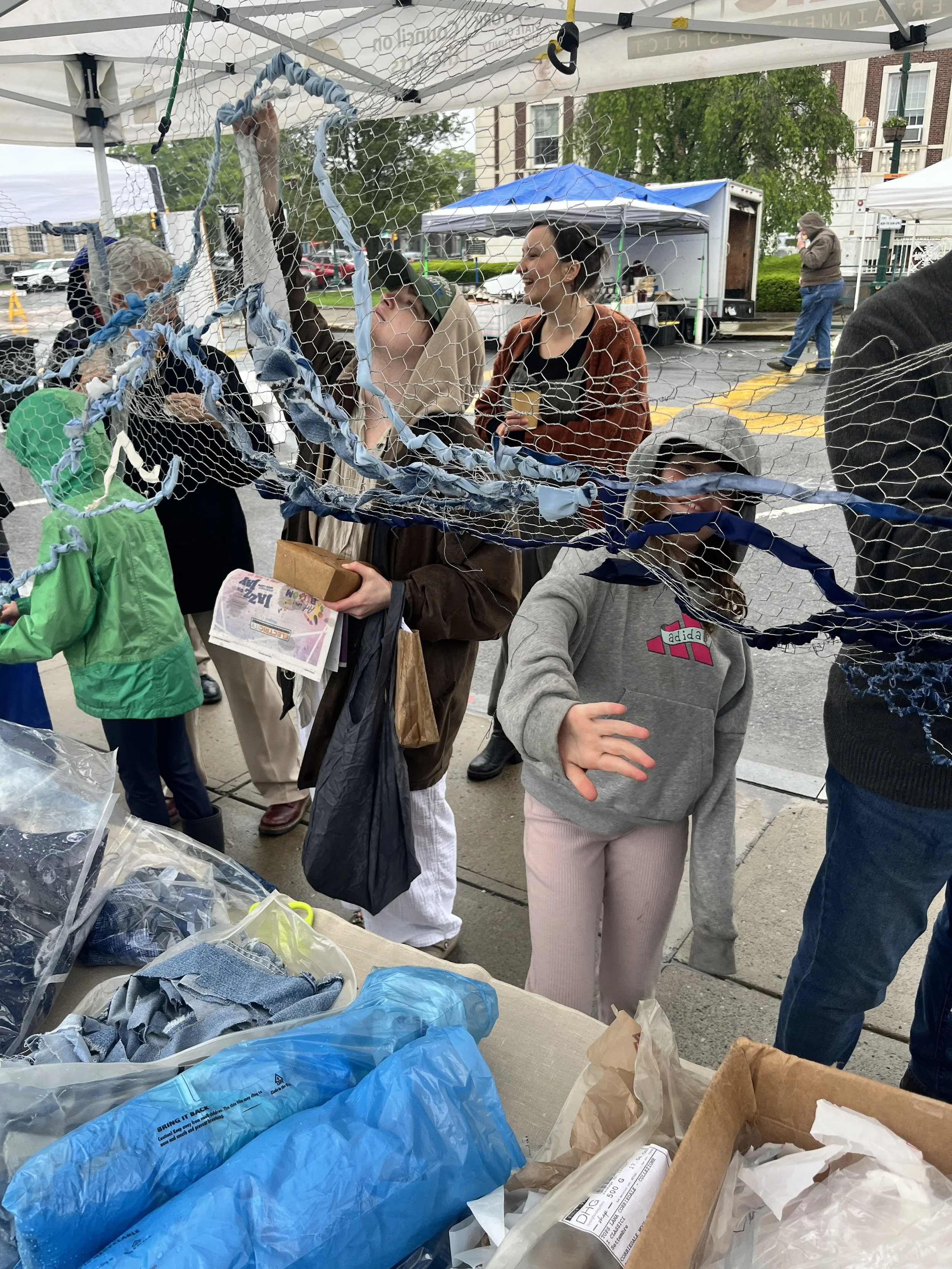
A community created textile sculpture, woven from donated clothing and plastic to learn more about our connections to our rivers, our shared histories, the textiles that shape our world and the living planet we call home.
Woven River is creating a time and space for us to gather and connect over the creation of fabric. Like the generations before us, stretching back to the dawn of civilization, we come together over a textile.
Throughout the weaving of this sculpture and collecting donated fabrics, clothing items and plastics, we hope to create a new understanding of the waters and fabrics that are threaded into our everyday lives. what it takes to make them, where they end up and how we can work to protect our waters and our connections to the land.
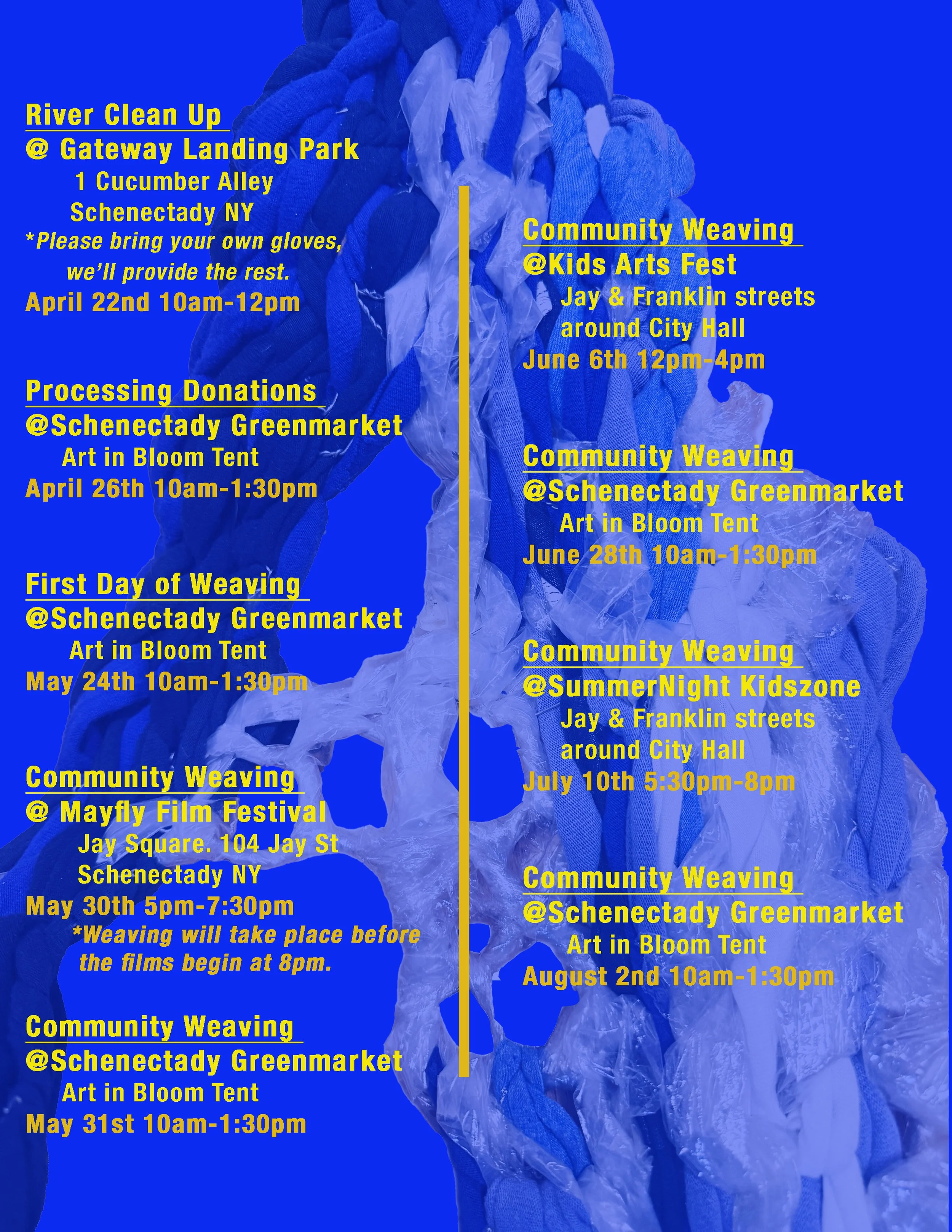
Water has always tied us to the land. Throughout time humans have settled around water from mesopotamia around Tigris and Euphrates to Schenectady around the Mohawk River . It’s been a source of life, travel, trade, sanitation, civilization. We have followed waters to new lands and let it lead us to fertile grounds for agriculture. It’s a life source, a power source, a source of poetry and passion. We can’t ignore our innate love of the water, our reliance on it and how we’ve molded it and sculpted it to suit our needs. Water has been woven into our story from the very beginning, threaded through our bodies, our towns and cities and our histories. No matter who you are or where you’re from, water ties us all together.
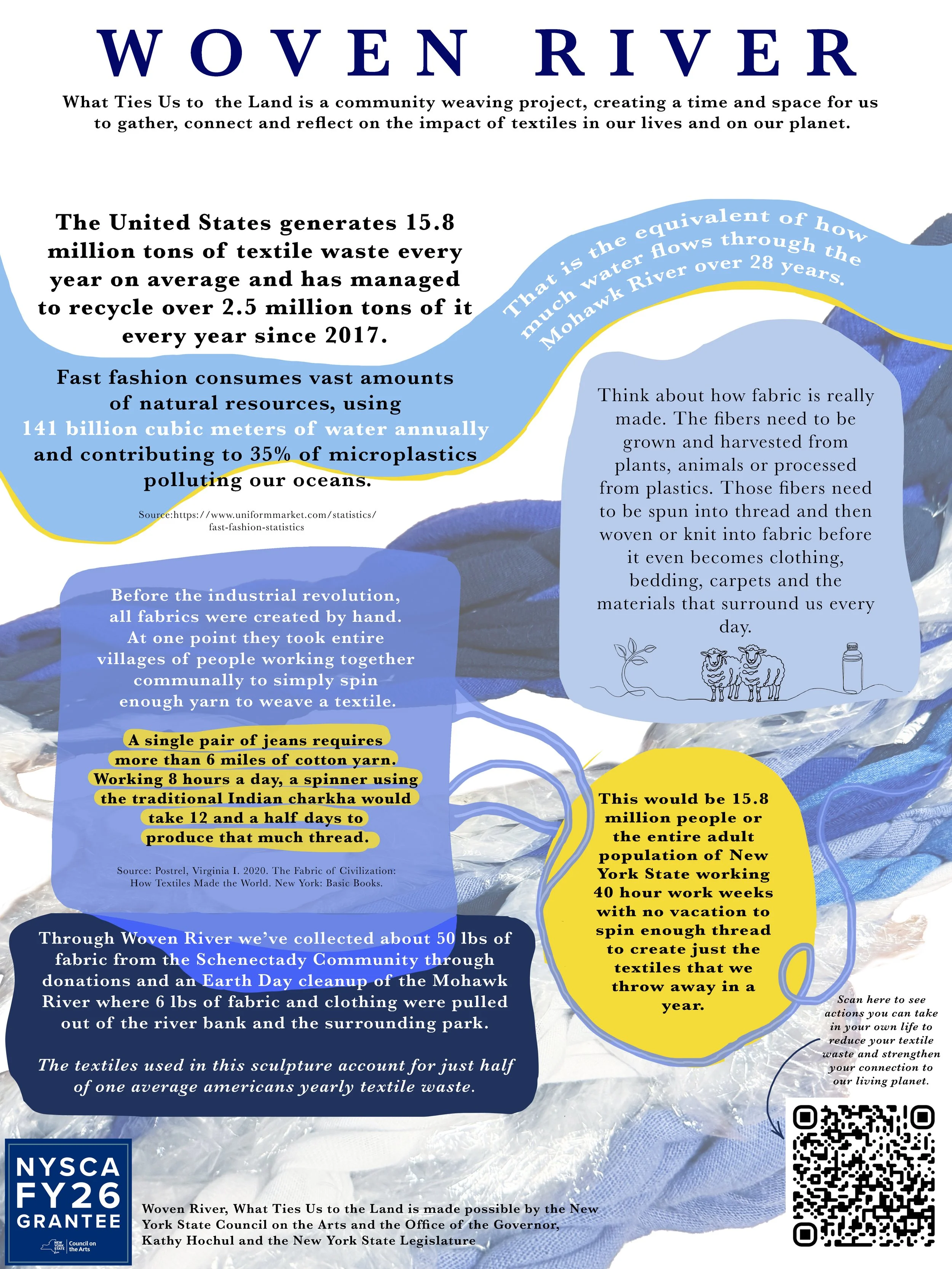
Textiles have also connected humans to the land, as long as there has been civilization, there has been the production of textiles. From the growing of the fibers to the dyeing of the cloth, textiles, water and humanity are inextricably bound together. The creation of textiles throughout our history was often a communal act, it took humans at a mass scale, working in connected ways across towns and cities to spin enough thread to weave the fabrics that clothed them.
“A single pair of jeans requires more than 6 miles of cotton yarn. Working 8 hours a day, a spinner using the traditional Indian charkha (a hand driven spinning wheel) would take 12 and a half days to produce that much thread”
We live in a strange time, where we have everything at our fingertips and because of that we lose sight of what it takes to to produce the material world we’ve built. We don’t see the fields of fiber crops, the vats of dye, the waste water it produces, the large factories spinning thread and weaving fabrics, the people who are stitching the garments together. The mass production of these materials made faster and cheaper by the day combined with our blindness to their production, they become disposable in our eyes and in the eyes of the companies producing them.
Textile waste and plastic waste chokes our landfills and our waterways. We’ve transformed the incredible powerful gift of water into the material that pollutes it. The USA alone dumpee close to 14 million tons of textile waste in 2018 with only 2.5 million tons recycled. Many of our textiles now are made with plastic fibers, acrylic, nylon, polyester. Plastic has become a dominant material in our modern world and it is single use plastics along with plastic microfibers that end up in our water ways, in the wildlife and the ecosystems they call home, circling back around to us. Microplastics have been found in our bodies from our brains to our guts and our hearts.
RESOURCES
-
To: Government officials at the municipal, state, provincial, and national level
We, the undersigned, urge you to stand with a growing international movement to protect rivers, freshwater ecosystems, and all who depend upon them for their lives and livelihoods.
You can do so by seeing to the adoption of the Universal Declaration of the Rights of Rivers in your country’s laws and ensuring its adoption results in the vital protections it guarantees.
Given the alarming degradation of rivers globally and the resulting harms to the climate, wildlife, public health, and local economies, we urge you to act without delay.
The declaration states that all rivers are:
Living entities.
Entitled to fundamental rights.
Entitled to legal guardians.
And that:
These rights shall extend to the health of watersheds and river basins.
Indigenous communities will be represented in river guardianship.
All states will implement these rights and provide the resources necessary to ensure they are realized.
-
For too long, the dominant culture has cleaved humans from the web of life, insisting upon human separation from and superiority to the larger living world. That assumption has been translated into law, governance, and other realms of practice, justifying the treatment of nonhumans and nature as treasure troves for endless exploitation. However, the grip of this mode of thinking is beginning to ease, leaving space for new ideas and actions to sprout through.
Within this context, and with an understanding that the time has come for systematically rethinking human relations with the living world, the More-Than-Human Life (MOTH) Program was born.
MOTH is an interdisciplinary initiative dedicated to the advancement of rights and well-being for humans, nonhumans, and the web of life that sustains us all. The Program has two primary goals. First, using the tools of the law, MOTH offers answers to key questions raised by a host of disciplines concerning human relationships—institutional, political, legal, and cultural—with the natural world, including in the context of pressing ecological challenges. These questions include:
-
The Schoharie River Center is a not-for-profit organization dedicated to educational and cultural programming about the Schoharie Creek and the communities which make up the Schoharie River Valley. Formed in 1999, it is a membership organization which sponsors and operates Environmental Study Team (EST) programs in the surrounding counties. Located in Burtonsville, NY, The Schoharie River Center is also active in a variety of community, historical and Cultural programs and activities.
-
Up-Stitch is a 501(c)(3) nonprofit creative reuse organization that collects donated fabric, yarn, and other sewing and needlework materials to distribute and sell back to the crafting community at an affordable rate. We endeavor to keep useful material out of landfills, facilitate creativity, and increase environmental awareness throughout the Capital District.
Our goal is to improve the planet by reducing our local carbon footprint through the recycling of fabric and yarn. By re-circulating these materials to the community, we keep them out of dumps and put them back into the hands of people that can use them. Our shop offers alternative, unique, and local choices for sewers and knitters to purchase. We create a sense of community that comes with sharing and helping others in their quest to create.
-
Born in Amsterdam in 2009, the Repair Cafe concept was brought to New Paltz by volunteer organizer John Wackman in 2013. His dedication, enthusiasm and success inspired others to launch Repair Cafe events in their communities which eventually became the Repair Cafe Hudson Valley (RCHV) network, now a program of the non-profit organization Sustainable Hudson Valley.
If you are interested in bringing a repair cafe to your community, we would be happy to point you in the right direction. You can also check out the Repair Cafe Foundation for resources, guidelines and all the details.
-
The Honest Weight Food Co-op, founded in 1976, is a member-owned and -operated consumer cooperative. We're committed to providing affordable, high-quality natural foods and products for healthy living. We are open to the public seven days a week to provide our community with the area's largest and best selection of local and organic produce and groceries.
An impressive bulk foods selection featuring over 900 items, including pantry staples (beans, nuts, dried fruits, pastas, honey, coffees, grains) and hard-to-find specialty ingredients, including unusual herbs and spices, seaweeds, gluten-free flours, and flavored salts.
On average the bulk department has kept over 182,000 packages from our landfills and oceans each year.
-
-
Plastic Pollution Coalition is a non-profit communications and advocacy organization that collaborates with an expansive global alliance of organizations, businesses, and individuals to create a more just, equitable, regenerative world free of plastic pollution and its toxic impacts.
-
The Ocean Cleanup. Every year, hundreds of thousands of tons of plastic enter the oceans, primarily from rivers. And the plastic that’s afloat within the oceans isn’t going away by itself. To effectively solve the problem, we need to both halt the trash flow from rivers, and remove legacy plastics from the oceans at the same time.
The Ocean Cleanup, a non-profit organization, is developing and scaling technologies to rid the world’s oceans of plastic. Our aim is to put ourselves out of business once the oceans are clean.
-
The Global Alliance for the Rights of Nature is a global network of organizations and individuals committed to the universal adoption and implementation of legal systems that recognize, respect and enforce “Rights of Nature”
Rather than treating nature as property under the law, the time has come to recognize that natural communities have the right to exist, maintain and regenerate their vital cycles.
Our members are a diverse network of scientists, attorneys, economists, indigenous leaders, authors, spiritual leaders, business leaders, politicians, actors, homemakers, students, activists: people from all walks of life in over 100 countries on 6 continents: North and South America, Africa, Europe, Asia and Australia who are looking to transform our human relationship with our planet
““A single pair of jeans requires more than 6 miles of cotton yarn. Working 8 hours a day, a spinner using the traditional Indian charkha would take 12 and a half days to produce that much thread” ”
reducing our textile waste together
Clothing in good condition can always be donated but consider organizing a clothing swap within your local community. clothing swaps start to create closed loop systems where clothing is shared, never thrown away.
clothing that is a little worse for wear could be mended. look for local mending circles to learn how to sew and patch clothing. mending is also a great way to add new style to your wardrobe through the japanese technique of sashiko stitching. clothing has history and mending them is a way of adding to their story and helping them last longer in your closet.
for clothing that cannot be repaired or donated, consider turning the item into rags for cleaning or if you are handy with sewing they can be turned into produce bags for grocery shopping, small pads for make up removal, towels to wrap up fresh greens in your fridge and so much more.
For old sheets, towels, pillowcases and textiles that fall into that category, animal shelters are great places to donate those fabrics.
For donating fabrics, Upstitch in Albany will take fabric and other fiber art supplies that can be resold
for all other donations
Mallory Zondag Awarded a New York State Council on the Arts Support for Artists Grant
Schenectady, NY -- Mallory Zondag received a Support for Artists grant from the New York State Council on the Arts (NYSCA) to support her creative work. Sponsored by Art in Bloom, this award will fund Woven River: What Ties Us to the Land. Through New York State’s continued investment in arts and culture, NYSCA has awarded $80.9 million in FY 2026 to arts and culture nonprofits across all 10 regions and a historic number of artists.
“New York’s arts and culture sector is a cornerstone of the state’s identity, and we're making bold investments to ensure it remains strong,” Governor Hochul said. “These grants will lift up artists and organizations in every region, fueling local economies and expanding access to the arts. Congratulations to all the grantees – your talent and dedication help power New York’s future.”
New York State Council on the Arts Executive Director Erika Mallin said, “During these challenging times, the New York State Council on the Arts has been a stalwart and innovative funder. These grants will serve artists and organizations in every region and county, fueling our economy and serving our communities. We know this support isn’t just an investment in the arts; it’s an investment in New York’s future. Congratulations to all our FY2026 grantees and thank you for your perseverance, your creativity, and your tireless service to New York State.”
New York State Council on the Arts Chair Patrick Willingham said, “With the unwavering support of Governor Hochul and our Legislature, the Council is proud to congratulate this year’s grantees, whose collective efforts strengthen and benefit us all. I also want to recognize the work of NYSCA’s panelists, staff, and the entire Council, whose dedication has ensured that this critical support will reach every corner of New York State.”
About the New York State Council on the Arts The mission of the New York State Council on the Arts is to foster and advance the full breadth of New York State’s arts, culture, and creativity for all. To support the ongoing recovery of the arts across New York State, the Council on the Arts will award over $161 million in FY 2026, serving organizations and artists across all 10 state regions. The Council on the Arts further advances New York's creative culture by convening leaders in the field and providing organizational and professional development opportunities and informational resources. Created by Governor Nelson Rockefeller in 1960 and continued with the support of Governor Kathy Hochul and the New York State Legislature, the Council is an agency that is part of the Executive Branch. For more information on NYSCA, please visit arts.ny.gov, and follow NYSCA's Facebook page, on X @NYSCArts and Instagram @NYSCouncilontheArts.